The Insulation Resistance Tester, also known as a Megohmmeter, is a vital tool in various industries like telecommunications, electricity, meteorology, and industrial enterprises. It’s essential for testing the insulation resistance of various materials and electrical equipment such as transformers, motors, and cables.
Features:
Display: Large LCD screen with gray-white backlight for clear visibility.
Functions: Includes data storage and access, an alarm system, and automatic shutdown.
Versatility: Capable of measuring both DC and AC voltage, absorption ratio, and polarization index.
Design: Robust construction offering shock, dust, and moisture resistance, ensuring durability and reliability.
User-Friendly: Offers ease of operation and portability.
Specifications:
Output Voltage Levels: Offers multiple levels, ranging from 100V to 5000V.
Insulation Resistance Measurement Range: From 0.01MΩ to 1000GΩ.
Voltage Measurement:
DC Voltage Range: 0 to 1000V.
AC Voltage Range: 0 to 750V.
Accuracy and Resolution: Varies based on the output voltage and measurement range.
Power Supply: Equipped with a 12.6V rechargeable battery.
Connectivity: Includes a USB interface for data transfer to computers.
Data Storage: Can store up to 500 data groups.
Safety and Compliance: Meets IEC61010-1, IEC1010-2-31, IEC61557-1,5, IEC60529(IP54), and other relevant standards.
Measuring Principle of Insulation Resistance
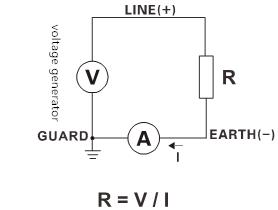
The insulation resistance measurement is conducted using a voltage generator that produces a specific voltage (V). This voltage is applied across the resistance to be measured. The principle involves monitoring the current (I) that flows through this resistance. The insulation resistance value (R) is then calculated using the formula R = V/I, where V is the voltage applied, and I is the current measured. This method effectively determines the resistance level, providing crucial insights into the insulation’s integrity.
Instrument structure
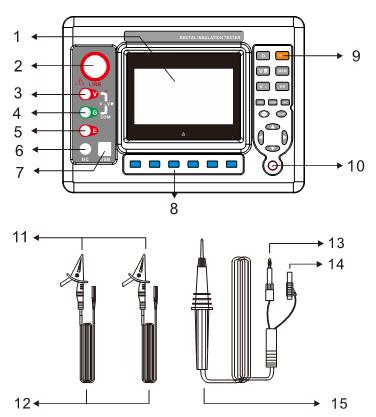
1. LCD display 2. LINE interface 3. V interface 4. GUARD interface 5. EARTH interface 6. Charging interface 7. USB interface 8. Voltage selection key 9. Test key
10. Power on/off button 11. Safety alligator clip 12. Test line (1 each for green and black) 13. Insert the banana plug of the high voltage test terminal into the LINE interface 14. Plug the shielded wire connector into the GUARD interface (no need to connect if there is no such connector) 15. High voltage rod test line